URUGUAY LAND MARKET REPORT 2026:
PRICES, TRENDS & INVESTMENT OUTLOOK
An overview of agricultural land prices, regional differences, and investment considerations, based on the latest official full-year transaction data.
Uruguay's rural property market continues to attract attention from investors seeking productive land, geographic diversification, and long-term ownership opportunities. With an established agricultural economy, a developed legal framework for property ownership, and a diverse range of productive landscapes, the country offers opportunities across livestock farming, commercial agriculture, forestry, and mixed-use rural estates.
The latest official figures, covering transactions completed during 2025 and published in March 2026, provide valuable insight into the direction of Uruguay's land market.
Agricultural Land Prices in Uruguay
According to Uruguay's Ministry of Livestock, Agriculture and Fisheries (MGAP), approximately 259,000 hectares of rural land changed ownership during 2025, through 1,718 recorded transactions.
The total value of these transactions exceeded US$1.08 billion, with an average price of US$4,178 per hectare.
This represents an increase of approximately 5% over the 2024 average of US$3,967 per hectare, continuing the upward movement in national average land prices.
At the same time, the total area sold declined by approximately 31% compared with the previous year. The combination of higher average prices and lower transaction volume illustrates why both pricing and market activity must be considered when evaluating conditions in Uruguay's rural property market.
The national average provides a useful benchmark, but it should not be interpreted as the market value of any individual property. Agricultural productivity, location, infrastructure, water resources, and permitted land use can result in substantial differences between properties.
Regional Differences in Land Values
Uruguay's rural land market is characterized by considerable regional variation.
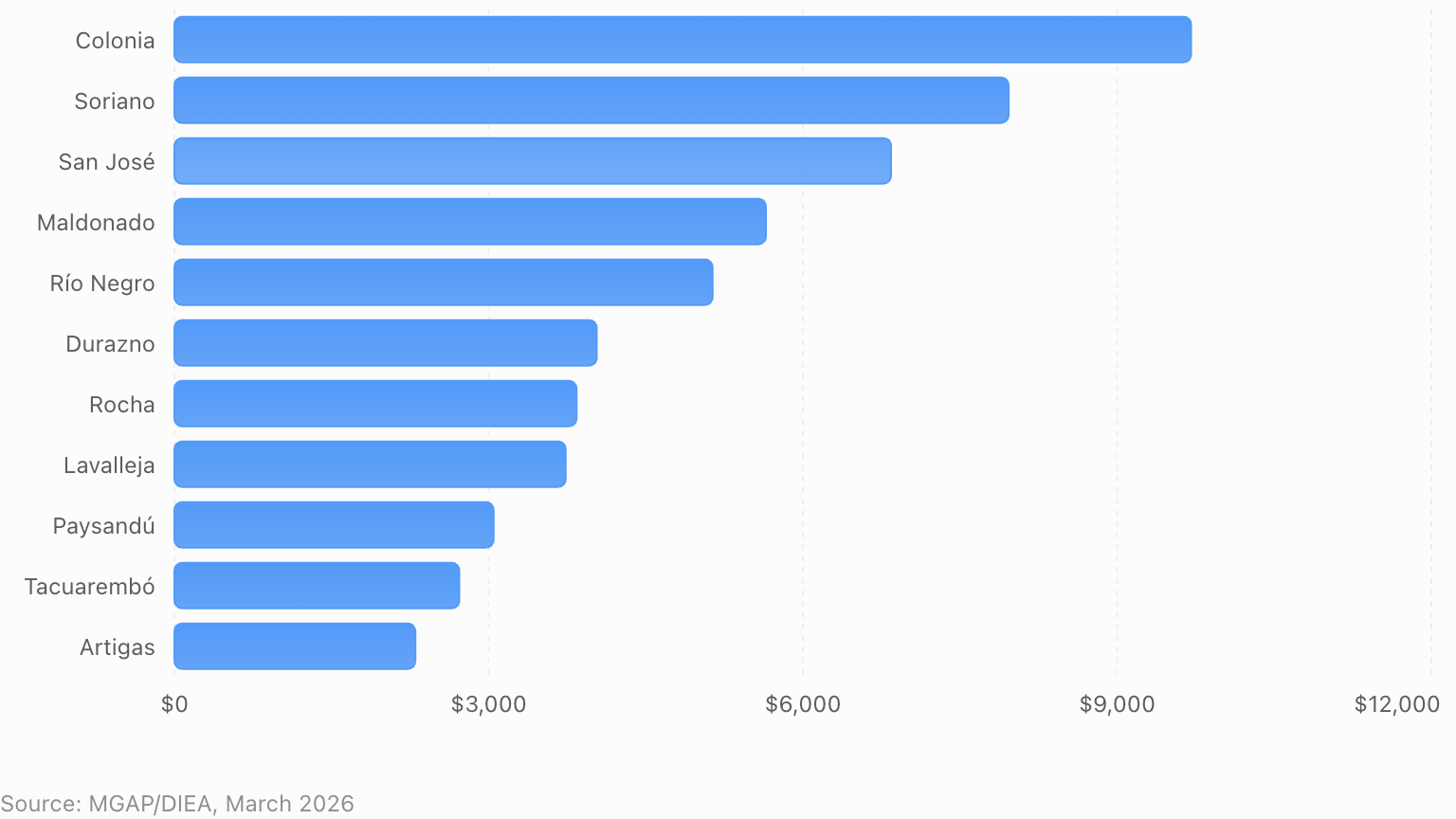
The country's southwest, particularly Colonia and Soriano, contains some of its most productive agricultural soils. These areas support intensive cropping and mixed agricultural operations and consistently command some of the highest average prices.
In contrast, northern and northeastern departments include extensive cattle-producing regions where land values are generally lower, reflecting differences in soil productivity, agricultural potential, and infrastructure.
Average Rural Land Prices by Department
The following figures represent recorded average transaction prices during 2025, as published by MGAP in 2026.
Source: MGAP/DIEA, 2025 rural land transactions. Department averages reflect the properties sold during the reporting period and are not valuations of all land within each department.
Productive Farmland and Agricultural Investment
High-quality agricultural soils remain an important segment of Uruguay's rural property market.
Properties suitable for commercial cropping are concentrated in regions with favorable soil characteristics, established agricultural infrastructure, and access to transport networks.
The productivity of a farm depends on more than its total area. Soil depth, drainage, topography, crop suitability, and water availability all influence its agricultural potential.
For investors evaluating commercial farmland, the CONEAT soil productivity index provides an important starting point. However, detailed agronomic analysis is necessary to establish the productive capacity of an individual property.
Existing irrigation infrastructure and the feasibility of developing additional water resources may also influence investment decisions, particularly where crop production is a principal objective.
Cattle Ranches and Extensive Grazing Land
Livestock production remains central to Uruguay's agricultural economy, and cattle ranches represent a substantial portion of the country's rural landscape.
Extensive grazing properties are found throughout Uruguay, particularly in northern, central, and eastern departments.
Land suitable for livestock production is evaluated according to factors including natural pasture quality, carrying capacity, water distribution, fencing, accessibility, and opportunities for pasture improvement.
For international investors, cattle ranches may offer several ownership and operating structures. Some properties are acquired for direct agricultural production, while others may be leased to established livestock operators.
The suitability of either approach depends on the property's characteristics, operating requirements, and the investor's financial objectives.
Forestry Land and Long-Term Investment
Forestry represents another established component of Uruguay's rural economy.
Commercial forestry operations are concentrated in areas with suitable soils, climate conditions, and access to processing facilities and transport infrastructure.
Forestry investments differ from conventional agricultural properties in several respects, including production cycles, capital requirements, management considerations, and the timing of potential income.
When evaluating forestry land, investors should consider soil suitability, existing plantations, species selection, plantation age, access roads, and proximity to processing and export infrastructure.
As with agricultural land, the value of a forestry property depends on its individual characteristics rather than a single national price benchmark.
Understanding the CONEAT Index
One of the distinctive features of Uruguay's agricultural land market is the availability of standardized soil productivity information.
The CONEAT index assigns relative productivity values to rural soils, with 100 representing the national reference level.
The index is widely used when comparing rural properties and assessing their productive characteristics.
However, CONEAT should not be treated as a complete measure of agricultural value. Properties with similar indices may differ considerably in water availability, accessibility, infrastructure, and suitability for particular farming activities.
A comprehensive assessment should therefore combine soil data with physical inspections, operational information, and local market comparisons.
What International Investors Should Consider in 2026
Uruguay's agricultural land market offers opportunities across several productive sectors, but individual investment strategies can vary significantly.
For investors considering an acquisition, several considerations are particularly relevant:
Productive potential: Assess soil characteristics, current land use, water resources, and opportunities for agricultural improvement.
Income generation: Evaluate existing operations, leasing possibilities, operating costs, and realistic income expectations.
Location and infrastructure: Consider access to roads, processing facilities, agricultural services, and export infrastructure.
Investment horizon: Agricultural and forestry properties generally require a long-term perspective, particularly where improvements or production cycles are involved.
Legal and technical due diligence: Verify ownership, boundaries, land-use restrictions, water rights where applicable, and other property-specific obligations.
Uruguay's national land price statistics offer a useful perspective on the market, but they cannot replace an individual assessment of a property's commercial and productive characteristics.
A Long-Term Perspective on Uruguay's Land Market
The latest official figures demonstrate that Uruguay's rural property market continued to record higher average land prices during 2025, even as the volume of land changing ownership declined.
For international family offices and private investors, Uruguay remains a market worth evaluating within a broader strategy of real asset ownership and geographic diversification.
The country's agricultural diversity provides opportunities ranging from productive cattle ranches and commercial farmland to forestry properties and mixed-use rural estates.
In collaboration with experienced agricultural land specialists, Christie’s International Real Estate Uruguay assists international investors in identifying and evaluating rural properties throughout the country.
Our approach focuses on understanding each investor's objectives and the characteristics of individual assets, with particular attention to productive capacity, long-term capital preservation, and income-generating potential.
Explore our selection of land investment opportunities in Uruguay or contact our team for further information about available properties and specialist advisory services.
Market data note: This report was prepared in November 2026 using official full-year 2025 rural land transaction statistics published by MGAP/DIEA in March 2026. Figures refer to completed transactions and do not represent current asking prices or guarantees of future investment performance.