PROPERTY INVESTMENT IN URUGUAY
Residential property prices, rental income and long-term investment considerations.
Uruguay attracts international property buyers seeking rental income, long-term capital appreciation and geographic diversification. Established destinations such as Punta del Este and José Ignacio offer residential investment opportunities supported by domestic and international demand.
As with any real estate market, financial performance depends on acquisition price, rental potential, operating expenses and resale conditions. Understanding these factors is essential when evaluating an investment.
Property Prices in Uruguay
Residential property prices vary significantly by location, property type and construction quality.
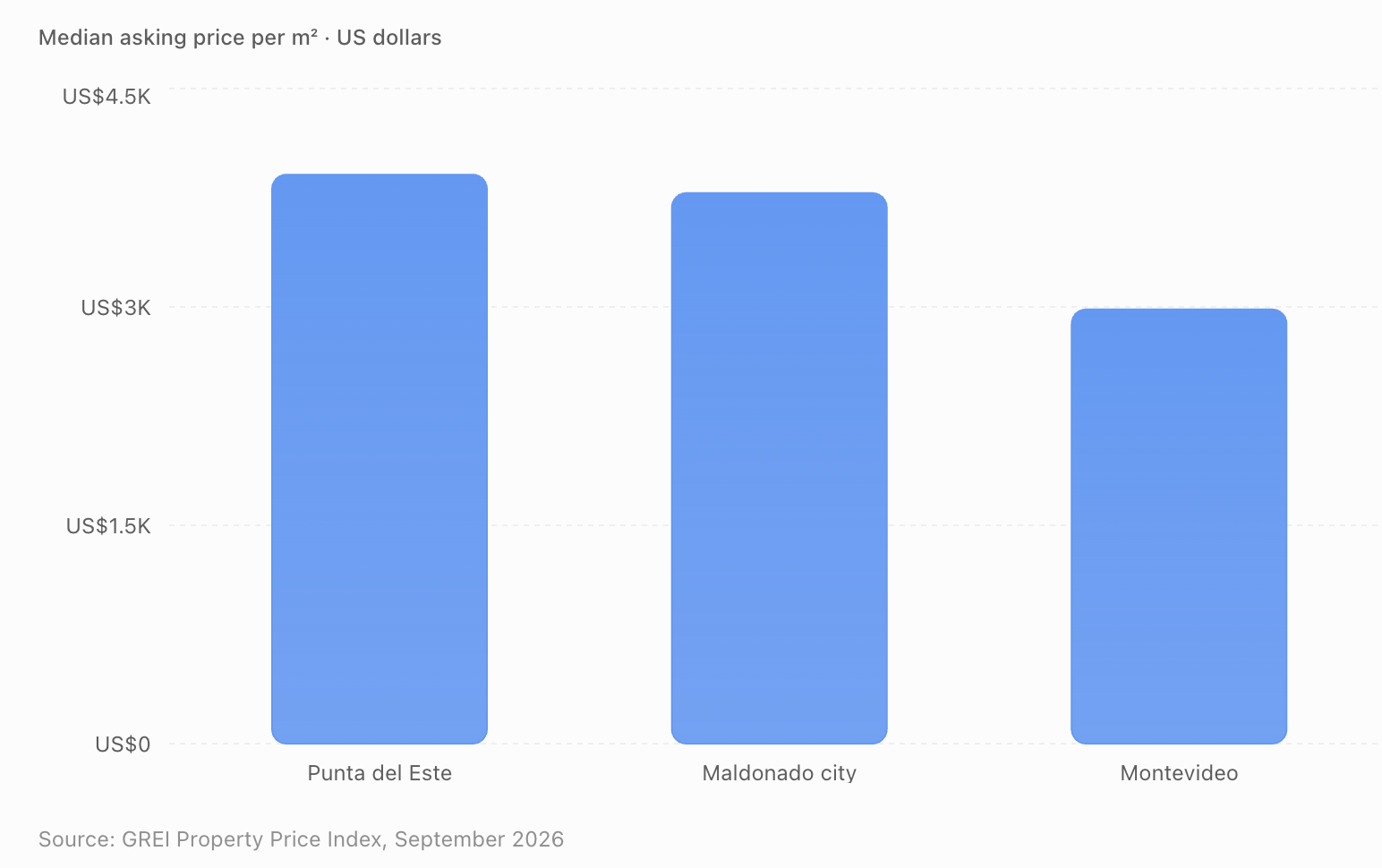
According to the GREI Property Price Index, the median asking price for existing apartments in Punta del Este reached US$3,909 per square meter in September 2026. This compared with US$3,782 in Maldonado city and US$2,983 in Montevideo.
The median asking price for newly constructed apartments in Punta del Este was US$4,091 per square meter.
These figures indicate that existing apartments in Punta del Este were advertised at approximately 31% above the equivalent median in Montevideo.
The data reflects advertised asking prices rather than completed transactions. It provides a general residential market benchmark and should not be interpreted as representative of luxury residences or individual property valuations.
Rental Income and Seasonal Demand
Rental income is an important consideration for investors in Uruguay's coastal residential market.
Punta del Este and neighboring destinations experience concentrated demand during the Southern Hemisphere summer, particularly between late December and February. Properties in established locations may achieve substantial seasonal rental rates, although occupancy and income can vary significantly throughout the year.
Investors should evaluate expected annual revenue rather than relying exclusively on peak-season rental prices.
Property management, maintenance, insurance, utilities, taxes and periods without tenants all affect net income. Furnishing and periodic improvements may represent additional costs, particularly in the premium rental market.
Understanding Rental Yields
Rental yield provides a useful starting point for comparing income-producing properties.
Gross rental yield measures annual rental revenue as a percentage of the property's acquisition price. Net operating yield takes operating expenses into account and provides a more realistic indication of income performance before financing costs and applicable income taxes.
For example, a property acquired for US$1 million and generating US$60,000 in annual rental revenue would produce a gross yield of 6%. If annual operating expenses amounted to US$20,000, the net operating yield would be approximately 4%.
These figures are illustrative rather than representative of typical returns in Uruguay. Actual yields depend on location, property characteristics, occupancy and operating costs.
Capital Appreciation
In addition to rental income, investors may consider the potential for long-term capital appreciation.
Changes in property values are influenced by local demand, available supply, infrastructure, neighborhood development and broader economic conditions.
Established residential locations with limited opportunities for additional construction may have different long-term characteristics from areas with substantial undeveloped land.
However, location and scarcity do not guarantee appreciation. The acquisition price remains a critical determinant of eventual investment performance.
Investors should also distinguish between increases in advertised asking prices and appreciation supported by completed transactions.
Property Selection and Financial Performance
Two properties with similar asking prices can produce substantially different financial results.
Important considerations include:
Acquisition price: The relationship between the purchase price, comparable properties and achievable rental income.
Rental demand: The property's appeal to prospective tenants and its potential occupancy throughout the year.
Operating costs: Maintenance, management, insurance, taxes and shared expenses.
Capital expenditure: Future renovations, replacements and improvements.
Resale potential: The size of the prospective buyer market and the property's competitiveness when offered for sale.
A property with strong rental demand may provide more consistent income, while another may depend primarily on appreciation to produce an attractive overall return.
Liquidity and Investment Horizon
Residential real estate is generally less liquid than publicly traded financial assets. Selling a property involves marketing time, transaction expenses and uncertainty regarding the final sale price.
Liquidity can vary considerably within the premium market. Properties with distinctive architectural features, substantial landholdings or exceptionally high prices may appeal to a relatively narrow buyer group.
Investors should consider their intended holding period and the potential costs of selling earlier than anticipated.
A longer investment horizon may provide greater flexibility, but it does not eliminate market risk or guarantee a positive return.
Measuring Total Investment Returns
A complete investment assessment considers both income generated during ownership and the financial result upon resale.
Relevant components include rental revenue, operating expenses, acquisition and selling costs, capital improvements, financing expenses and applicable taxes.
An investment generating modest rental income may still produce a favorable total return if its resale value increases sufficiently. Conversely, strong rental income does not necessarily compensate for an unfavorable acquisition price or a decline in property value.
Evaluating several potential scenarios provides a more useful basis for decision-making than relying on a single projected return.
Investment Advisory
Christie's International Real Estate Uruguay assists international buyers in identifying residential properties that correspond to their financial objectives and intended ownership period.
Our team provides local market insight, property comparisons and access to selected opportunities in Punta del Este, José Ignacio and the surrounding coastal region.
We also coordinate with independent legal, tax and technical professionals where specialist advice is required.
This article is intended for general information and does not constitute financial, legal or tax advice. Rental income, capital appreciation and investment returns are not guaranteed.